
Updated: October 22, 2026
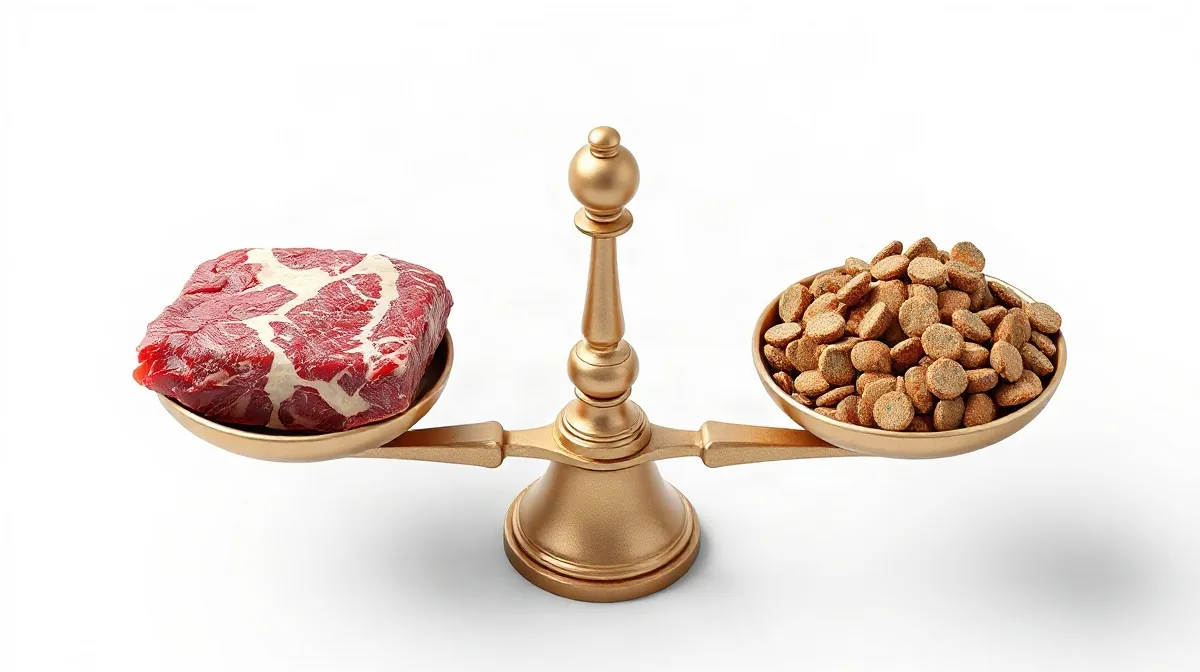
Raw and commercial dog foods can both be fed as part of a dog’s diet, but they differ sharply in evidence, food-safety risk, preparation and cost. The important comparison is not simply “natural” versus “processed”: it is whether the food is complete and balanced for your dog’s life stage, whether its risks fit your household, and whether you can feed it consistently. In the United States, check the package’s nutritional adequacy statement and discuss medical or growth needs with your veterinarian.
What are the nutritional differences between raw and commercial dog food?
Raw food may contain uncooked muscle meat, organs, bones or ground bone; products sold as raw can be frozen, freeze-dried or refrigerated. Commercial food includes dry kibble, canned food and cooked fresh diets. Comparing guaranteed-analysis percentages on labels can mislead: canned food contains far more water than kibble, and raw products vary in moisture. For a fair comparison, convert nutrients to a dry-matter basis or compare calories and nutrient amounts per 1,000 kcal.
Protein and fat levels depend on the recipe, not just whether it is raw. A food’s protein percentage does not establish that its amino-acid profile is adequate, nor does a high percentage prove better health. In the United States, the Association of American Feed Control Officials (AAFCO) publishes nutrient profiles and model labeling rules; it does not approve or certify individual brands. Look for a statement that the food is complete and balanced for the intended life stage, or that it is for intermittent or supplemental feeding only. AAFCO’s growth profile includes large-size dogs expected to reach 70 lb (31.8 kg) or more as adults.
How to compare labels
- Moisture matters: dry kibble is commonly much lower in water than canned food, so as-fed protein percentages are not directly comparable.
- Check the adequacy statement: identify whether the recipe is intended for growth, adult maintenance, or all life stages; a treat or topper is not necessarily a complete diet.
- Ask about formulation: AAFCO nutrient-profile compliance or a feeding trial is more informative than claims such as “ancestral,” “premium,” or “human-grade.”
| Feature | Raw food | Commercial cooked food |
|---|---|---|
| Common formats | Frozen, refrigerated or freeze-dried | Kibble, canned or cooked fresh |
| Moisture and label comparison | Varies by format; compare on a dry-matter or calorie basis | Kibble is relatively dry; canned food is high in moisture |
| Nutrition check | Verify complete-and-balanced status and intended life stage | Verify the same statement on the package |
| Pathogen control | Freezing does not reliably eliminate bacteria | Cooking reduces pathogens when manufacturing controls are effective |
What are the health benefits of raw dog food?
Owners sometimes report a shinier coat, firmer stools or improved appetite after changing foods. Those changes may reflect a different fat level, ingredient, calorie intake or digestibility; they do not demonstrate that raw feeding itself is responsible. There is not strong clinical evidence that raw diets generally improve energy, allergies or overall health compared with a nutritionally complete cooked diet. For suspected food allergy, a veterinarian may recommend a controlled elimination diet using a veterinary therapeutic hydrolyzed-protein or novel-protein food, rather than an unstructured switch to raw.
Raw meaty bones are sometimes promoted for dental cleaning, but chewing bones can fracture teeth, cause choking or intestinal obstruction, and expose dogs and people to pathogens. The American Veterinary Medical Association (AVMA) advises against feeding animal-source protein that has not been treated to eliminate pathogens. For oral care, use toothbrushing with dog toothpaste and products carrying the Veterinary Oral Health Council (VOHC) Seal of Acceptance; a dental examination can identify disease that a diet will not treat.
What to do if a dog seems better after a food change
- Keep a record of the food, daily amount, treats, stool quality and skin signs, and change one major variable at a time.
- Ask your veterinarian to assess persistent itching, vomiting, diarrhea or weight change rather than assuming an allergy.
- Examples of commercial raw-product makers include Primal Pet Foods and Stella & Chewy’s; a brand name alone does not establish that a product is complete, pathogen-free or suitable for a particular dog.
What are the risks associated with feeding raw dog food?
Raw meat can carry Salmonella, Campylobacter, Listeria monocytogenes and disease-causing E. coli. Dogs may become ill or shed organisms without obvious symptoms, contaminating bowls, floors, feces and hands. The risk is especially consequential where a household includes a child under 5, an adult aged 65 or older, a pregnant person, or someone with a weakened immune system. The U.S. Food and Drug Administration (FDA) and Centers for Disease Control and Prevention (CDC) advise against feeding raw pet food because of these pathogen risks.
Freezing at −18°C (0°F) may stop some parasites from developing, but it does not reliably kill Salmonella or other bacteria. Homemade recipes also risk nutrient imbalance. In growing puppies, excess or inadequate calcium and an unsuitable calcium-to-phosphorus balance can harm skeletal development.
Risk reduction and safer handling
- Do not thaw raw pet food on the counter; thaw it in a sealed container in the refrigerator and follow the package’s storage and discard instructions.
- Wash hands with soap and water after handling, and clean bowls and food-contact surfaces promptly; keep raw food and its utensils separate from human food.
- Do not rely on freezing, “human-grade” wording or a company’s testing claim as proof that a product is pathogen-free.
- For a homemade diet, have the recipe formulated for the individual dog by a board-certified veterinary nutritionist (DACVIM-Nutrition or ECVCN); do not improvise meat, bone and organ ratios.
How does commercial dog food ensure safety and nutrition?
In the United States, FDA rules under the Federal Food, Drug, and Cosmetic Act require animal food to be safe, produced under sanitary conditions, free of harmful substances and truthfully labeled. FDA-regulated facilities are also subject to applicable preventive-control requirements under the Food Safety Modernization Act. AAFCO is not a government regulator; its model nutrient profiles and feeding-trial protocols are used by state regulators and manufacturers as a basis for nutritional adequacy claims.
Commercial cooking and quality controls can reduce microbial hazards, although no manufacturing process makes recalls or contamination impossible. A package should identify the product, net quantity, ingredients, guaranteed analysis, feeding directions and nutritional adequacy information. Ask the manufacturer who formulates the diet, what quality-control testing is performed, and whether it can provide typical nutrient analyses. Royal Canin is one example of a company selling life-stage and breed-marketed formulas, but the adequacy statement and the dog’s needs matter more than breed-specific packaging.
Questions to ask a manufacturer
- Is a qualified nutritionist involved in formulation, and are finished products checked against the declared nutrient profile?
- Are ingredients and finished batches tested for relevant pathogens and contaminants, and can the company explain its recall process?
- Is the food intended as a complete diet or only as a topper, treat or supplement?
How do costs and convenience compare between raw and commercial dog food?
There is no dependable universal daily price: package size, calories per cup or patty, local retail prices, delivery fees and the dog’s calorie requirement all change the total. Compare foods by the cost of the calories your dog actually needs, not by bag price or a generic “20 kg dog” estimate. Include treats, supplements, freezer electricity, shipping and food that must be discarded after thawing. A veterinarian can help estimate calorie needs, then you can calculate daily cost from the product’s kcal per package.
Kibble is generally shelf-stable before opening and easy to portion. Canned food takes more storage space and opened cans need refrigeration. Frozen raw requires freezer capacity, advance thawing and careful cleaning; freeze-dried raw is lighter to store but still requires attention to handling and package directions. A diet that fits the budget and routine is more likely to be fed consistently.
Make a like-for-like budget
- Find the product’s metabolizable energy in kcal/kg or kcal/package and calculate the daily amount from your dog’s feeding plan.
- For each candidate, divide the package price by the number of days the package lasts at that amount; add delivery and storage costs.
- Compare a complete food with another complete food, not a raw topper with a full ration.
| Format | Price comparison method | Storage and handling |
|---|---|---|
| Frozen raw | Price per package divided by days fed at the prescribed calories | Freezer, refrigerator thawing, separate cleaning routine |
| Freeze-dried raw | Compare package calories and rehydration directions; do not compare scoop volume alone | Dry storage before opening; follow handling instructions |
| Dry kibble | Compare cost per 1,000 kcal or per feeding day | Sealed, dry storage; straightforward portioning |
| Canned food | Include the number of cans needed to supply daily calories | Refrigerate leftovers according to label directions |
Frequently asked questions
Is raw dog food better for all dogs?
No. There is no established general health advantage that makes raw food preferable for every dog, while pathogen exposure and formulation errors are real concerns. Puppies, pregnant dogs and dogs with health conditions need an appropriate complete diet selected with a veterinarian.
Can raw food cause illness in dogs or humans?
Yes. Raw food can carry Salmonella, Campylobacter, Listeria and pathogenic E. coli. A dog may shed bacteria without appearing sick, so safe handling cannot remove household risk entirely.
How can I balance a homemade raw diet?
Have a board-certified veterinary nutritionist formulate the full recipe, including an exact supplement plan for the dog’s life stage and calorie needs. Muscle meat, organs and bone by themselves do not guarantee adequate calcium, trace minerals or vitamins.
Are commercial dog foods nutritionally complete?
Many are, but check the package’s AAFCO nutritional adequacy statement. It should identify the intended life stage or state that the food is for intermittent or supplemental feeding only. AAFCO does not approve individual brands.
Key takeaways
- Compare complete-and-balanced status and calories, not “raw” or “premium” claims or protein percentages alone.
- Raw food may carry Salmonella, Campylobacter, Listeria and pathogenic E. coli; freezing does not reliably eliminate these hazards.
- Raw bones can fracture teeth or cause choking and obstruction; brushing and VOHC-accepted dental products are safer options for oral care.
- FDA regulates U.S. animal-food safety and labeling, while AAFCO publishes model nutrient profiles and feeding-trial protocols rather than certifying brands.
- Price diets by the calories fed and include storage, delivery and handling costs; consult a veterinarian before changing food for a medical concern.
For most households, a complete commercial food with a clear life-stage adequacy statement is the simpler way to limit foodborne-pathogen exposure while meeting nutrient needs. Raw feeding is not proven to deliver broad health benefits, and careful handling cannot make it risk-free. If you are considering raw food or a homemade recipe, discuss the dog’s age, health, household members and nutritional requirements with your veterinarian first.