
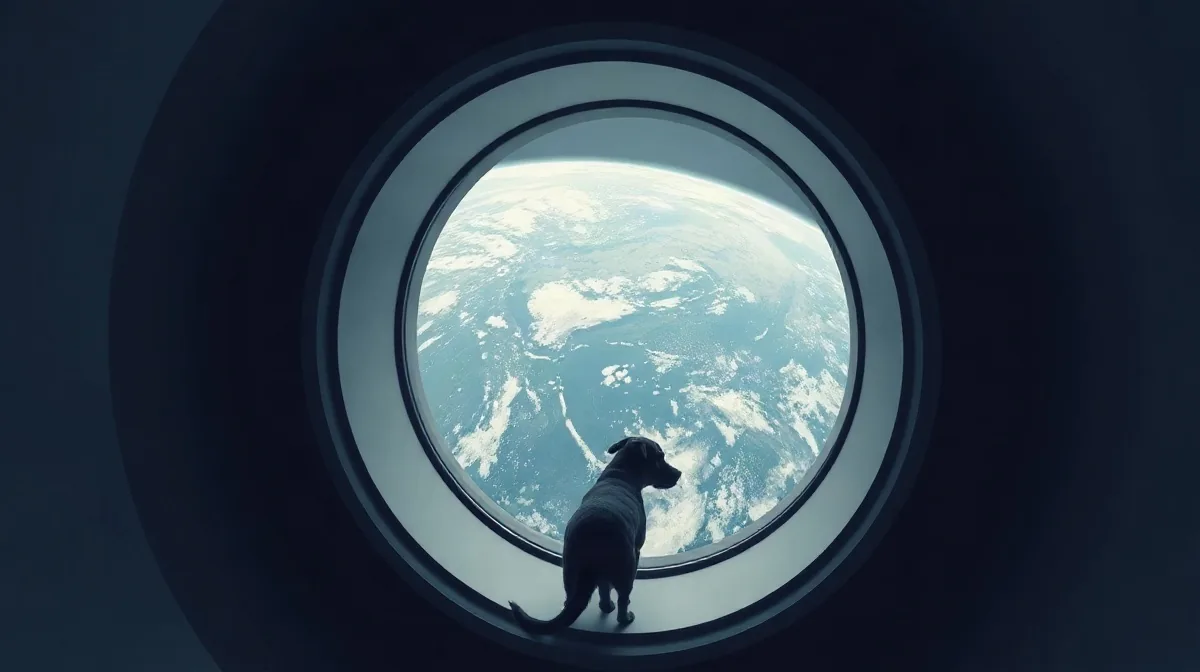
Sending animals into space is ethical only when the expected scientific benefit justifies the risks and suffering, and no suitable alternative exists.
Laika’s flight made that question impossible to treat as abstract. Her story sits at the point where scientific ambition meets an animal’s inability to consent, and where the value of knowledge must be weighed against the cost imposed on a living creature.
This article examines Laika and the ethics of sending animals into space: what responsibility researchers have to the animals they use, and how those obligations should shape decisions about future missions.
| Decision point | Laika’s mission | Welfare question |
|---|---|---|
| Scientific purpose | Animal sent into orbit aboard Sputnik II | Was animal use necessary for the objective? |
| Monitoring | Respiration and heart rate changed during flight | Could distress be detected and addressed? |
| Recovery | No appropriate retrieval strategy | Could the animal return safely? |
| Outcome | Sputnik II disintegrated with Laika’s remains onboard | Was the harm avoidable or justified? |
- 103 beats to 240 beats per minute change in Laika’s heart rate during the flight
- 1957 year Laika was launched aboard Sputnik II
- 1958 year Sputnik II re-entered Earth’s upper atmosphere
What happened to Laika aboard Sputnik II?
Laika could not return alive from Sputnik II: the Soviet Union launched her in 1957 as the first animal to orbit Earth, but the mission had no appropriate retrieval strategy.
Sputnik II was designed to carry Laika into orbit, not bring her back. Its scientific purpose did not include a safe return for its animal passenger, so there was no plan to recover her alive after the flight.
How the mission ended
Sputnik II re-entered Earth’s upper atmosphere in 1958 and disintegrated with Laika’s remains still aboard. The spacecraft’s return was not a recovery operation; it ended the mission without bringing Laika back to Earth.
That outcome is central to the ethical question surrounding Sputnik II. Laika was sent on a one-way mission in which the scientific objective did not provide for her survival or return. The distinction matters: the problem was not simply that the spacecraft later disintegrated, but that a safe return for its living passenger had never been part of the plan.
Who was Laika before Sputnik II?
Laika was a stray dog selected for Sputnik II, the mission that made her an early participant in space research. Before the spacecraft carried her into orbit, she was an individual animal chosen for a programme whose public meaning was often framed as national achievement.
Scientists gave Laika nicknames including Kudryavka, meaning “Little Curly,” Zhuchka, meaning “Little Bug,” and Limonchik, meaning “Little Lemon.” The names make her easier to picture as a particular dog rather than an anonymous passenger in a spacecraft.
A dog, not equipment
Sputnik II’s mission was a one-way journey: Laika was sent into orbit without a strategy to bring her back. Her death makes the ethical question concrete. The subject of the mission was a sentient animal, not interchangeable equipment, and the scientific purpose does not erase what was done to her.
Laika’s identity matters because discussion of the mission can otherwise focus on national achievement and technological progress while leaving the animal out of view. Her nicknames restore some of that individuality; they also sharpen the question of what responsibility researchers have when an animal is made to bear the risks of an experiment.
What did Laika’s flight show about the cost of the mission?
Laika’s flight showed that the mission’s scientific value came at the cost of severe physiological stress and a death that was built into its design. During the flight, her respiration increased three to four times, and her heart rate rose from 103 beats to 240 beats per minute.
Those changes make the animal-welfare issue concrete: Laika’s body was under acute strain, and there was no plan to bring her back. Her death was not an unforeseen complication during recovery. Sputnik II was a one-way mission, and Laika was knowingly sent on it without a return plan.
Scientific value and animal harm
The flight produced information about how a living animal responded to spaceflight, but that result cannot be separated from the conditions under which it was obtained. Laika could not consent to the risks, and the mission offered her no way to leave them behind.
That is the ethical measure the flight leaves behind: scientific results must be weighed against the harm imposed on the animal, especially when the animal has no choice. The question is not only what a mission learns, but whether that knowledge justifies the suffering its design requires.
How should animal research in space be judged?
Animal research in space should be judged by whether it is necessary, whether harm can be reduced, and whether the animal can be recovered and cared for afterward. Laika’s flight aboard Sputnik II made those questions urgent: she was knowingly sacrificed to advance science, and her mission raised concerns about animal testing and mistreatment.
The Soviet Union’s ambition and competitiveness help explain the mission’s context, but they do not decide whether its cost to Laika was justified. Scientific value cannot by itself answer whether an animal’s suffering was avoidable or whether the experiment should have gone ahead.
What to examine in a proposed mission
- Necessity: Is using an animal essential to the research, or can the question be answered without one?
- Housing and monitoring: Does the plan provide suitable living conditions and ways to track the animal’s condition throughout the mission?
- Distress response: Is there a clear response if the animal shows signs of distress, and can that response prevent further harm?
- Recovery and aftercare: Can the animal return from the experiment, and what care will it receive afterward?
Laika had no appropriate retrieval strategy; she re-entered Earth’s upper atmosphere and died with her remains aboard. Any proposal that cannot explain how an animal will be retrieved and cared for should face that fact as a central welfare question, not an afterthought.
When does the case for sending animals into space fail?
A mission fails a basic welfare test when it has no appropriate retrieval strategy and knowingly leaves an animal to die in space, as happened to Laika aboard Sputnik II.
Laika’s mission made the conflict plain: a scientific objective does not, by itself, justify the harm imposed on an animal. The mission’s purpose, the animal’s conditions, the available alternatives and the prospect of recovery must each be assessed separately. A result that advances science cannot substitute for a plan to protect the animal.
Laika’s experience also cannot settle every ethical question about later animal research in space. Missions may differ in purpose, conditions and protections, so each needs its own assessment rather than a blanket verdict drawn from one case.
What to check in a proposed mission
- Animal-care standards: Identify the specific standards that govern the animal’s care during preparation, flight and recovery.
- Enforceable protections: Check what rules apply to the mission and how compliance is required, rather than relying on general assurances of ethical progress.
- Recovery plan: Look for an appropriate retrieval strategy; without one, the animal may be knowingly exposed to an unrecoverable death.
- Alternatives and harm: Ask whether the scientific purpose requires animal involvement and how its expected harms are weighed separately from the hoped-for findings.
Before accepting a claim that a space mission treats animals more ethically, check the named care standards and enforceable protections that apply to that specific mission.
Frequently asked questions
Was Laika the first animal in space?
Could Laika return to Earth?
What happened to Sputnik II?
Why is Laika’s mission still an ethical issue?
Sources
- rte.ie — “A short history of sending animals into space”
- The Science Survey — “Laika the Space Dog: The Ethics of Animal Experimentation”
- jeevoka.com — “Jeevoka – The One Way Trip to Space That Changed Everything”
- theconversation.com — “We’ve been sending animals into space for 7 decades – yet there are still no rules to protect them from harm”
- figopetinsurance.com — “Unsung Story Laika Space Dog: Insights for Pet Parents”