
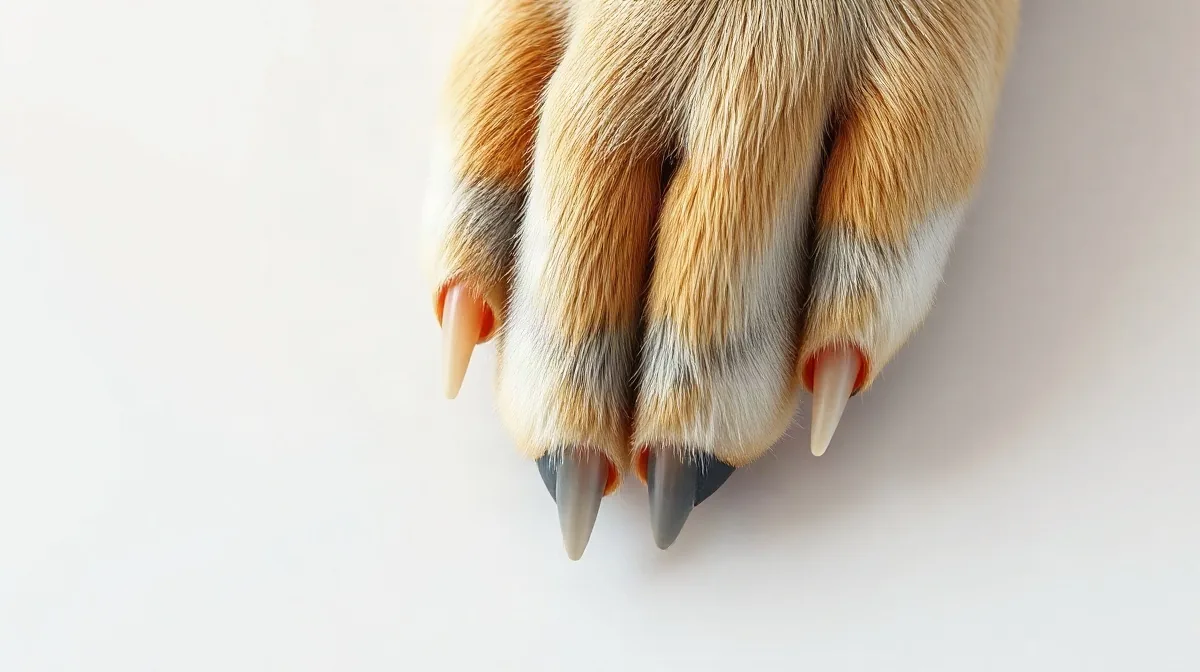
The quick is the living tissue inside a dog’s nail, and it ends where the nail’s blood supply and nerves stop. Its position varies, so there is no single safe cutting point for every nail.
Trim only the hard nail beyond the quick; cutting into it can cause pain and bleeding. In light-coloured nails, the quick is often visible as a pink area. Dark nails make it harder to see, so take off small amounts at a time and stop if you spot a dark centre.
| Nail appearance | What to look for | Stopping cue |
|---|---|---|
| White nail | Cut surface changes colour | Stop when it turns pink |
| Dark nail | Interior becomes white and chalky | Stop when a black dot appears in the centre |
| Any nail | Natural curve becomes sharper | Avoid cutting into the soft inner quick |
| Nail after trimming | Bleeding or pain | Stop and use styptic powder if needed |
- 12-year duration of a longitudinal study documenting nail growth in beagles
- 27 beagles aged 1 to 16 years dogs followed in the longitudinal nail-growth study
- 71% of 35 surveyed dog owners who considered claw trimming necessary
What is the quick, and where does it run?
The quick is the soft, living tissue inside a dog’s nail, containing nerves and blood supply; cutting into it can cause pain and bleeding. It generally follows the nail’s curve and begins near the point where the hard outer nail bends more sharply.
The trimming aim is to shorten the nail close to the quick without cutting into that tissue. The outer surface can hide where the quick runs, so look at the nail’s cut end as well as its shape.
Viewed from the end, a nail can show its inner structure more clearly than its outer surface. That cross-section helps you judge how close the living tissue is as you trim.
How does nail colour show where to stop?
White nails show where to stop when the cut surface turns pink; dark nails require small trims until a black dot appears in the centre of the white, chalky area.
- White nail: Remove a little at a time and inspect the cut surface. Stop when it turns pink, before cutting into the quick.
- Dark nail: Take off small portions rather than a large piece, checking the cut surface after each trim. Near the quick, the inside may look white and chalky; a black dot in the centre of that area marks the quick’s end.
Check every nail separately. Colour and visibility can vary between nails, even across the same dog’s paws, so the signal you see on one nail may not be visible on another.
How do nail growth and everyday wear affect the quick?
Nail growth and everyday wear affect how often a dog needs trimming, but the quick’s position and the visible stopping point matter more than following one schedule for every dog.
A 12-year longitudinal study followed 27 beagles aged 1 to 16 years and documented nail growth rates; growth stayed steady or rose slightly up to 3 years of age. These findings describe beagles, so they do not set a trimming interval for every dog.
Walking can wear nails down through contact with the ground. Nails that do not meet the ground may get less natural abrasion and need closer monitoring. In a survey of 35 dog owners, 71% considered claw trimming necessary for their pets, though that view does not determine how often an individual dog needs it.
Use the nail, not the calendar, as your guide
Check each nail’s length and the visible quick before trimming. On a dark nail, remove small portions and stop when a black dot appears in the centre of the white cut surface. On a white nail, stop when the cut surface turns pink. The quick contains nerves and blood supply; cutting into it can cause pain and bleeding.
When is a trim overdue, and what can movement change?
A dog’s nails are due for trimming when they touch the ground while the dog stands; long claws can make walking uncomfortable and, in extreme cases, curl over and dig into a paw pad.
A standing check is a practical starting point, not a measure of how far to cut. Trim cautiously: the quick is the soft center containing nerves and blood supply, so cutting into it can cause pain and bleeding.
Movement measurements also changed around trimming. Before trimming, front-paw length was 2 mm longer (p = 0.022), while medio-lateral center-of-pressure movement was 1% of paw width lower (p = 0.018). These findings describe measured differences; they do not establish that every dog will walk differently after a trim.
Check the dewclaws
Dewclaws sit on the inside of the leg and may not wear down through ordinary walking. Check them along with the other nails, even if those nails are clear of the ground.
What should you do if you cut into the quick?
If you cut into your dog’s quick, stop trimming that nail and use styptic powder to control the bleeding; the cut can cause pain as well as bleeding.
Keep styptic powder beside you before you start, so it is ready if a trim goes too deep. Don’t continue cutting the affected nail to make it match another one. Wait until the bleeding is controlled and your dog can tolerate being handled before deciding whether to resume.
Choose a trimmer you can control
Scissor-style and guillotine-style trimmers are the two common options. Scissor-style trimmers may be easier for many people to handle.
- Scissor-style trimmers: A common choice if their handling feels easier and more controlled to you.
- Guillotine-style trimmers: The other common option; use them only if you can position the nail steadily.
If your dog is still distressed or the bleeding has not stopped, leave the remaining nails for later rather than forcing the session to continue.
Frequently asked questions
Where does the quick begin?
How can I tell where to stop on a dark nail?
What does the quick look like in a white nail?
What should I keep nearby before trimming?
Sources
- petassure.com — “How to Safely Trim Dog Nails”
- Caring Hands Animal Hospital — “How to Trim Dog Nails”
- stjamesanimalhospital.com — “About Us – Saint James Animal Hospital”
- Susan Garrett's Dog Training Blog — “Cutting Your Dog's Nails . . . How Important Is it Really?”
- Dremel — “How to Avoid Hitting the Nail Quick | Dremel”