
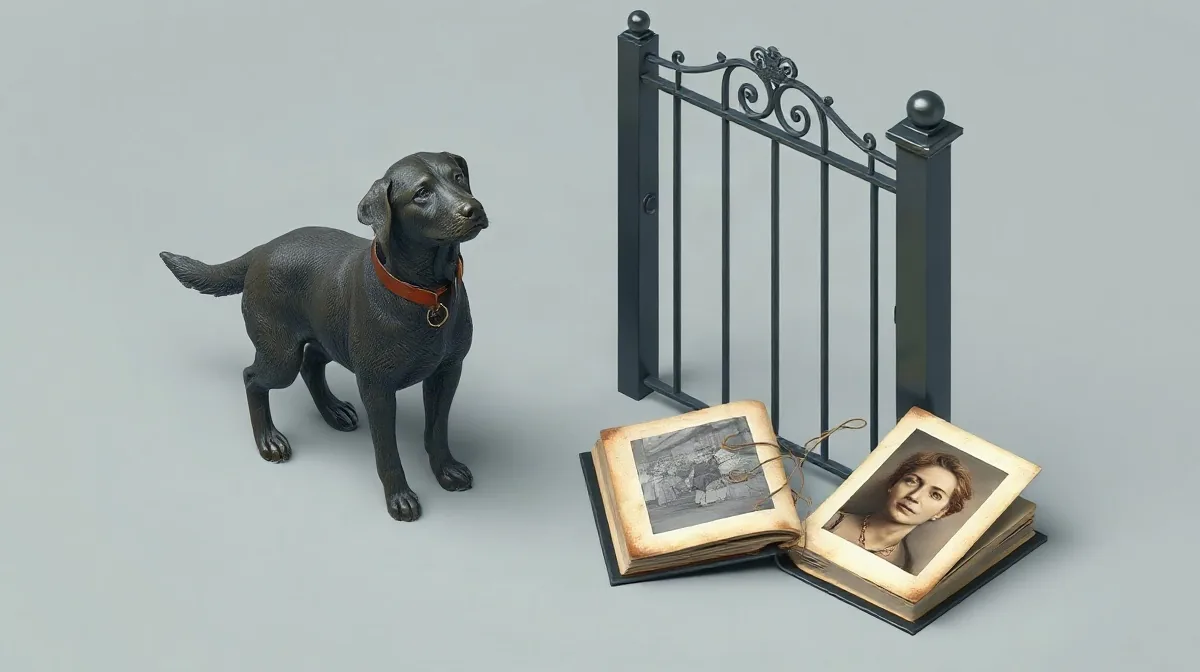
Greyfriars Bobby’s story is as much about how people turn a dog into a symbol as it is about loyalty. The familiar tale invites a closer look at what is remembered, and why.
The Edinburgh dog is celebrated for supposedly keeping vigil at his owner’s grave, a story that has lasted far beyond its original setting. Its enduring appeal says something about the bond people imagine between dogs and the humans they love.
Looking closely at Greyfriars Bobby’s story means separating the meaning of the legend from the questions surrounding its history.
| Detail | What can be stated | How to treat it |
|---|---|---|
| Bobby’s death | He died in 1872. | A dated biographical detail |
| Burial | He was buried in Greyfriars Kirkyard near John Gray. | A physical memorial detail |
| The grave-side vigil | The familiar account says Bobby stayed by Gray’s grave. | A central part of the story, but not every detail is settled |
| Number of dogs | Jan Bondeson proposes there may have been two Bobbys. | A disputed interpretation |
| Public memory | A bronze fountain and the 1961 Walt Disney film commemorate the story. | Evidence of the legend’s reach, not proof of every event |
- 13 shillings Jock’s annual salary as a policeman
- 1872 Year Bobby died
- 2011 Year Jan Bondeson published research examining surviving photographs of Bobby
- 1961 Year of the Walt Disney film about Greyfriars Bobby
What was Greyfriars Bobby’s story?
Greyfriars Bobby’s story is the remembered account of a dog who stayed by his owner John Gray’s grave in Greyfriars Kirkyard after Gray died, a vigil that speaks to attachment rather than proving every detail is settled.
Gray is remembered as Bobby’s owner and companion. Their shared life gives the tale its emotional force: Bobby’s devotion is tied to a particular person, not to a claim about an inherent trait of any breed. As a comparison, Jock’s annual salary as a policeman was 13 shillings.
The familiar account says Bobby remained at Gray’s grave for 14 years. Bobby died in 1872 and was buried in the same cemetery, a few feet from Gray’s grave.
That burial place gives the story a concrete anchor in Greyfriars Kirkyard, but it does not settle every detail of the vigil. The careful way to tell Bobby’s story is as a lasting account of attachment between a dog and the person remembered as his companion.
What was recorded about Bobby near the time of his death?
An obituary in the Scotsman in January 1872 described Greyfriars Bobby as “a poor but interesting dog”, placing him in public notice near the end of his life.
The obituary’s brief description is a contemporary record of Bobby’s public profile, not a detailed account of his daily behaviour. It offers less certainty about what he did from day to day than later retellings that present his routine as settled fact.
How Bobby’s story reached visitors
James Brown, the caretaker at Greyfriars cemetery, was the first person to tell visitors Bobby’s story. That makes Brown an early source of the tale as it circulated at the cemetery, distinct from the obituary’s account in a newspaper.
Jock’s annual salary as a policeman was 13 shillings. The figure gives a concrete glimpse of working life in the period; it does not establish Bobby’s routine or prove how often he accompanied Jock.
What can photographs and later research establish?
Photographs and later research can raise questions about which dog appears in surviving images and whether one animal fits every episode in Greyfriars Bobby’s familiar story, but they cannot prove the whole cemetery account.
In 2011, Swedish historian Jan Bondeson published research examining surviving photographs of Bobby. In Greyfriars Bobby: The Most Faithful Dog in the World, Bondeson proposes that there may have been two dogs called Bobby. He also argues that the dog in the familiar account was not necessarily the dependable figure later retellings describe.
What the photographs can—and cannot—show
A photograph records a particular dog at a particular moment, but identifying that dog across different images requires more than a shared name or a familiar pose. Differences between photographs may prompt questions about identity and chronology; they do not, by themselves, establish when each image was taken or which dog was present at the grave.
That distinction matters because Bobby’s story joins several claims: a dog’s identity, its repeated presence in the cemetery, and its relationship to John Gray. Photographs may help test parts of that account when considered alongside dates and other evidence. They cannot independently verify every episode or settle whether a single dog stayed by Gray’s grave throughout the story.
When should the story be treated as legend rather than settled fact?
Treat Greyfriars Bobby’s long vigil as a celebrated account, not proof that every detail of his identity and behaviour is settled. The distinction matters because an obituary, a later biography, a memorial and a film are different kinds of records.
What the record supports
The 1872 obituary is an early account of Bobby’s story; later biographies add interpretation, while memorials and film helped the tale travel beyond Edinburgh. A bronze fountain in the cemetery commemorates Bobby, and the 1961 Walt Disney film brought the story to a wider audience. Neither commemoration, by itself, settles questions about the dog’s identity or conduct.
What remains disputed
Jan Bondeson’s biography Greyfriars Bobby: The Most Faithful Dog in the World proposes that there were in fact two Bobbys. That is an interpretation, not an established replacement for the familiar account. It leaves the central claim of a long vigil alongside uncertainty about whether one dog can be identified consistently across the story.
- 1872 obituary: an early account to distinguish from later retellings.
- Jan Bondeson’s biography: a later proposal that there were two dogs, not a settled answer.
- Bronze fountain and 1961 film: commemorations that helped preserve and spread the tale, rather than independent proof of every detail.
For a careful reading, keep those layers separate: the obituary, later biographical claims, the cemetery fountain and the film each serve a different role in Bobby’s story.
Why does Greyfriars Bobby still matter to dog lovers?
Greyfriars Bobby still matters because his story gives a public shape to a private bond: visitors can recognise a dog’s attachment to one person even while the exact history remains debated.
Greyfriars Kirkyard makes that account tangible. Bobby’s grave is in the cemetery where the story places his vigil beside John Gray’s grave, so the remembered relationship is tied to a real place visitors can see.
Bobby and Bum represent different kinds of remembrance
- Greyfriars Bobby: His story centres on devotion to John Gray, whose grave is in Greyfriars Kirkyard.
- Bum: Edinburgh commemorates him in Prince’s Gardens. He was a stray adopted by the city, rather than a dog remembered for faithfulness to one person.
The contrast explains why Bobby’s story has a distinct hold on dog lovers. Bum became a city’s dog; Bobby is remembered through a particular human relationship. That difference lets visitors encounter more than a local symbol at Greyfriars Kirkyard: they encounter a story about attachment, made visible in the place where Bobby was buried.
Frequently asked questions
Who was Greyfriars Bobby?
When did Bobby die?
Did Greyfriars Bobby really guard one grave for years?
What did the Scotsman obituary say about Bobby?
Key takeaways
- Bobby died in 1872 and was buried near John Gray in Greyfriars Kirkyard.
- The Scotsman obituary of January 1872 called him “a poor but interesting dog”.
- Jan Bondeson examined surviving photographs in research published in 2011.
- Bondeson’s proposal of two Bobbys remains a possibility, not a settled conclusion.
- Edinburgh’s Bum memorial represents a different story: a stray adopted by a city.
Sources
- Scottish Tours — “The True Story of Greyfriars Bobby”
- historic-uk.com — “The Story of Greyfriars Bobby”
- Parliament House Hotel — “The Story of Edinburgh's Greyfriars Bobby”
- edinburgh.org — “The tale of Greyfriars Bobby – Forever Edinburgh”
- Trip Moments — “[2026 Edinburgh Attraction] Greyfriars Bobby Statue Travel Guide & Travel Experiences | Updated Nov”