
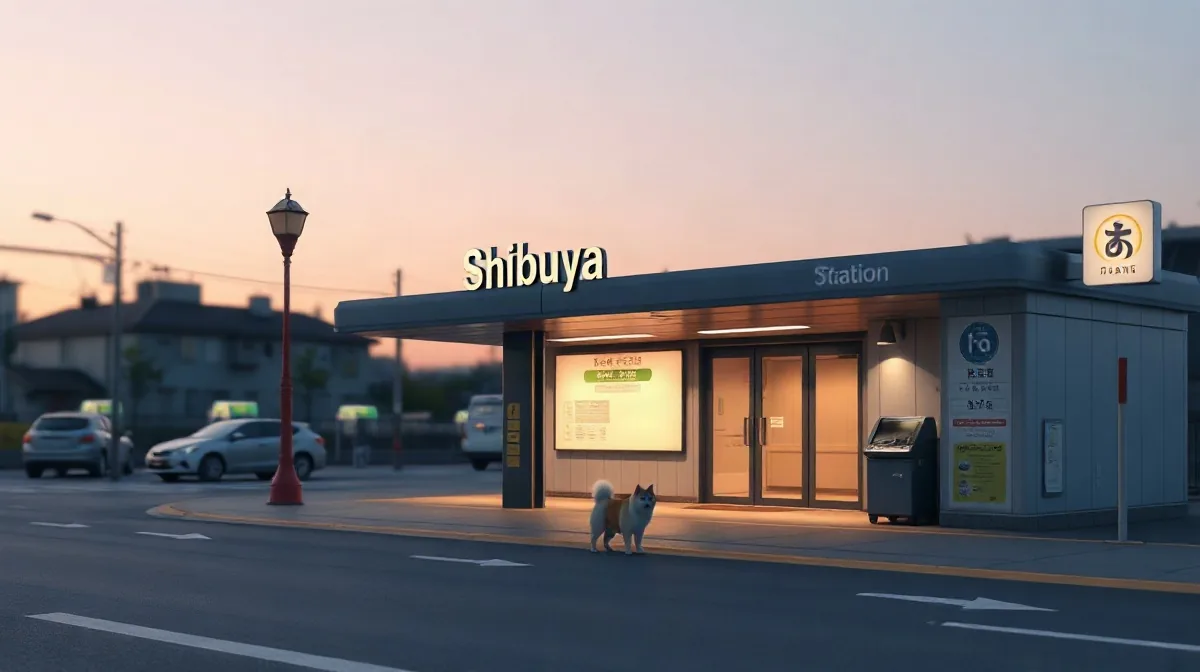
Hachikō’s story became a legend because the Akita returned to Shibuya Station for years after his owner died. His bronze statue now makes the station a meeting place and a reminder of that loyalty.
Hachikō was the dog of Hidesaburō Ueno, a professor at the University of Tokyo. Their daily routine ended with Ueno’s death in 1925, but Hachikō kept returning to the station. The story spread beyond Shibuya, turning one dog’s habit into a lasting symbol of devotion.
The statue is the familiar face of the legend; the story behind it is rooted in a real bond, a station and the people who noticed Hachikō’s return.
| Episode | What it establishes | What it does not establish |
|---|---|---|
| Daily trip with Ueno | Hachikō accompanied Ueno to Shibuya and waited in the evening | A precise train-time schedule |
| Ueno’s death | Ueno died unexpectedly at work on May 21, 1925 | What Hachikō understood about the death |
| Continued station visits | Hachikō kept returning until March 8, 1935 | A perfectly uninterrupted routine or fixed hour |
| Hachikō Monogatari | A 1987 film narrates his life and imagines a spiritual reunion | That the reunion occurred in documented history |
| Futurama tribute | “Jurassic Bark” echoes the waiting-dog motif through Seymour | An event in Hachikō’s biography |
- 1924 Year Hachikō was brought to Tokyo
- May 21, 1925 Date Professor Hidesaburō Ueno died
- nine years, nine months, and 15 days Stated duration of Hachikō’s continued visits to Shibuya
- March 8, 1935 Date Hachikō died
- 2013 Year of the ceremony marking the 90th anniversary of Hachikō’s birth
What happened to Hachikō and Professor Ueno?
Hachikō was a purebred Akita brought to Tokyo in 1924 by Professor Hidesaburō Ueno; he accompanied Ueno to Shibuya Station and waited there each evening for his return.
Ueno died unexpectedly at work on May 21, 1925. Hachikō kept visiting Shibuya Station after his owner’s death, continuing the evening wait until Hachikō died on March 8, 1935.
The Akita-inu is designated a “natural monument” by Japan’s Agency for Cultural Affairs.
How long did Hachikō return to Shibuya?
Hachikō returned to Shibuya Station for nine years, nine months, and 15 days after Professor Hidesaburō Ueno died, continuing until Hachikō’s own death on March 8, 1935.
The visits began before Ueno’s death. In 1924, Hachikō accompanied his owner to Shibuya Station and met him there in the evening; after Ueno died at work on May 21, 1925, Hachikō kept returning.
“Waited for Ueno” is the familiar way to describe those later visits, not evidence that Hachikō understood death or consciously planned a vigil. The documented span gives the duration, but it should not be confused with claims about an exact train arrival or a fixed daily timetable.
What is known about Hachikō’s life after Ueno died?
After Professor Hidesaburō Ueno died, Hachikō continued going to Shibuya Station, but accounts describe a disrupted life rather than an uninterrupted daily ritual.
Accounts say Hachikō lived with different families away from the station before he ended up with Ueno’s gardener, Kikusaburo Kobayashi, in the summer of 1925. He continued visiting Shibuya from there, still associated with the place where he had waited for Ueno.
Some contemporary accounts also report that Hachikō was neglected and occasionally mistreated at the station. These reports are accounts of his treatment, not settled detail; the visits themselves should not obscure the changes in where he lived and who cared for him.
How did film turn Hachikō’s life into a story?
Historical record and screen versions
The films turn Hachikō’s documented wait at Shibuya Station into different stories, but their invented scenes should not be treated as evidence about the historical dog’s life.
Hachikō Monogatari, the 1987 Japanese film directed by Seijirō Kōyama, tells Hachikō’s life from birth to death and includes a spiritual reunion with his master. That reunion is a cinematic interpretation, not a documented event in Hachikō’s life.
- Hachikō Monogatari: follows Hachikō’s life and gives the story a spiritual ending.
- The 2009 film starring Richard Gere: moves the story to Rhode Island and centers on Professor Parker Wilson and a lost puppy.
For the historical account, keep the films’ settings, characters and endings separate from claims about Hachikō’s movements and relationships.
Why did Hachikō become a symbol of loyalty?
Hachikō became a symbol of loyalty because he kept returning to Shibuya Station to wait for Professor Hidesaburō Ueno after Ueno died, turning an ordinary daily routine into a lasting story of devotion.
Before Ueno’s death, Hachikō accompanied him to the station and waited for his return in the evening. The familiar pattern continued without Ueno, making the change easy to grasp: the dog still came, though the person he expected would not return.
Public attention and admiration transformed Hachikō’s repeated visits into a widely shared image of devotion. He was an Akita-inu, a breed designated a “natural monument” by Japan’s Agency for Cultural Affairs.
That symbolism should not replace Hachikō’s individual life or turn his behavior into a standard for other dogs. Dogs respond to loss and routine in different ways; loyalty does not require them to wait at a station.
How has Hachikō been remembered beyond Shibuya?
Hachikō has been remembered beyond Shibuya through ceremonies, film, and popular culture, with each retelling emphasizing a different part of the bond between a dog and his owner.
In 2013, a special ceremony marked the 90th anniversary of Hachikō’s birth, turning his story into a public commemoration as well as a familiar account of loyalty.
The 2002 Futurama episode “Jurassic Bark” offers a separate tribute: Fry finds the fossilized remains of Seymour, who waited outside Panucci’s Pizza for 12 years. Seymour’s story echoes Hachikō’s waiting, but it is an homage—not evidence about Hachikō’s own life.
Which details of Hachikō’s wait should be treated cautiously?
Claims about Hachikō’s exact train timing and daily schedule should be treated cautiously unless supported by a reliable account. The firm timeline is that Professor Hidesaburō Ueno died on May 21, 1925, and Hachikō died on March 8, 1935.
Stories that Hachikō arrived at 3 PM, visited in both the morning and evening, or followed a precise train schedule add detail that should not be treated as established fact without corroboration. His visits’ emotional meaning is an interpretation, not a date or timetable.
A retelling can preserve the human significance of Hachikō’s wait while distinguishing the documented dates from vivid claims about when he appeared at Shibuya Station.
Sources
- nerdnomads.com — “The Amazing And True Story Of Hachiko The Dog”
- rarehistoricalphotos.com — “Hachiko: The True Story of a Loyal Dog Who Waited For His Deceased Owner for Ten Years – Rare Historical Photos”
- Nippon.com — “Hachikō, the Faithful Dog”
- Dogs in History — “Hachikō: Tokyo’s Loyal Dog of Shibuya Station”
- nahf.org — “Hachikō: Faithful Dog's 9-Year Wait for Owner's Return”