
Dog training improves behavior and supports health when it uses clear, consistent methods that teach good habits, reduce stress, and encourage safe movement and mental engagement. The best training is not just about obedience; it helps a dog live more comfortably and fit better into daily life.
That is why dog training belongs at the center of responsible ownership, alongside nutrition, exercise, grooming, and regular care. A well-trained dog is often easier to manage, less reactive, and more confident, which can make everyday routines calmer for both pet and person.
In this article, we look at how dog training can shape behavior while also supporting physical and emotional well-being. For a wider foundation on the subject, see our overview «Dogs: A Complete Guide to Health, Care, Training, and Everyday Ownership».
Whether you are working on basic manners or trying to build better habits at home, the goal is the same: help the dog learn in a way that is practical, humane, and sustainable. Good training does more than correct problems — it creates a healthier relationship between dogs and the people who care for them.
| Approach | Best use | Main limitation |
|---|---|---|
| Positive reinforcement | Teaching new behaviors and building reliability | Needs good timing and consistent rewards |
| Marker training | Pinpointing the exact correct moment | Works only if the marker is used the same way every time |
| Management with leash, harness, or mat | Preventing mistakes while habits are still forming | Does not teach the behavior by itself |
| Punishment-based correction | May stop a behavior briefly | Can create fear, confusion, or incomplete learning |
- 4 cues core behaviors emphasized here: sit, down, stay, come
- 3 tools basic home-training aids: treats, clicker or marker word, leash/harness
- 2-5 minutes a practical length for many beginner practice bursts
- 1 marker one consistent click or word used to pinpoint the correct behavior
What makes dog training work best?
Reward the exact behavior
Dog training works best when the dog is rewarded the moment it does the right thing, because immediate treats, praise, or play make the connection between the cue and the reward clear. Use one cue such as “sit,” “stay,” or “come” for each behavior, and keep the reward tied to that specific action so the dog does not guess.
Short, repeatable sessions are easier for dogs to learn from than long, tiring drills. A few minutes at a time is enough to keep the lesson sharp, especially when the same cue and the same reward are used consistently.
- Treats: best for fast, precise rewards right after the behavior.
- Praise: useful when the dog responds well to voice and attention.
- Play: a strong option for dogs motivated by movement or toys.
Build from quiet to distracting settings
Training should begin in the same familiar place so the dog can learn the behavior without extra pressure. Once the cue is reliable there, add one new distraction at a time, such as a different room, another person, or a noisier outdoor space.
This step-by-step approach helps the dog understand that the same cue still means the same action even when the environment changes. It also reduces confusion, because the dog is not asked to master a new behavior and a new setting at the same time.
How do you teach the basic behaviors every dog should know?
Core cues for home and outdoors
Teach sit, down, stay, and come first, because those four cues make everyday life safer and easier for both dog and handler. Start with very short sessions, then add loose-leash walking in brief stretches before you expect a full neighborhood walk without pulling.
- Sit and down: use them as the first calm-control skills at home, before meals, doors, or greetings.
- Stay and come: practice them in low-distraction spots first, then increase distance and noise gradually.
- Loose-leash walking: work in short segments, not a whole walk, so the dog learns the pattern before the environment gets harder.
Handling practice for real-life care
Use a marker such as a clicker or one consistent word to mark the exact instant the dog succeeds, so the reward is tied to the right behavior. That timing helps the dog connect the cue with the action, whether you are shaping a sit, a recall, or a calm leash step.
Handling practice should include being touched on the paws, ears, and collar, because those are the contact points that matter during grooming and vet visits. Keep the touches brief and predictable, then reward calm acceptance so the dog learns that exam-style handling is normal, not a threat.
Why does training help a dog’s mental and physical health?
Training helps a dog’s mental and physical health by giving the day a clear pattern, adding brain work that can tire many dogs, and making exercise safer and more controlled. It also cuts down on household friction around doors, food bowls, guests, and grooming, so everyday interactions feel less stressful for both dog and owner.
Mental work that burns energy
Repeated learning sessions ask a dog to focus, remember cues, and solve small problems, which uses energy in a different way than running or playing. A short practice block for sit, stay, or handling exercises can leave a dog calmer than an unstructured hour of chasing excitement because the work is organized and predictable.
- Structure: regular sessions create a routine, so the dog knows when to work and when to rest.
- Brain load: cue practice, impulse control, and reward timing all add mental effort.
- Home behavior: better manners can reduce tension near doorways, food bowls, guests, and grooming tools.
Safer movement in daily routines
Loose-leash walking and recall training can turn outdoor time into more controlled exercise, with fewer lunges, sudden pulls, or unplanned sprints. That makes daily movement safer and often more useful, because the dog can stay engaged with the handler instead of bouncing between distractions.
Recall also matters when a dog is off leash or in open spaces, because coming back quickly helps keep activity within safe limits. When the dog is easier to guide at home and outside, training supports both physical conditioning and emotional steadiness.
When do common training methods stop working?
Mistakes that weaken progress
Common training methods stop working when rewards arrive too late, come too infrequently, or are not valuable enough for the dog to care about. A cue also loses meaning if it is repeated 10 times without follow-through, or if one person allows the behavior while another blocks it.
- Timing: reward the behavior immediately, not after a long delay.
- Consistency: use the same cue and the same rule every time, including on weekends and with every family member.
- Value: switch to a higher-value reward if the dog ignores the current one.
Punishment-based methods may suppress barking, jumping, or pulling for a short time, but they do not teach an alternative behavior. That is why training can look “fixed” for a few days and then fall apart again when the pressure disappears.
When behavior may be a health issue
If fear, pain, or a sudden change in behavior appears, training alone is not enough and a veterinary check is needed. A dog that suddenly resists a cue, flinches, or changes temperament may be reacting to discomfort rather than disobedience.
- Sudden onset: a new problem that starts in days, not months.
- Pain signs: flinching, guarding, stiffness, or reluctance to move.
- Fear signs: cowering, freezing, or avoiding a known cue.
In those cases, the first step is to rule out a medical cause before adjusting the training plan. Once health is addressed, behavior work becomes clearer, safer, and usually more effective.
What tools and routines make training easier at home?
Simple gear that supports consistency
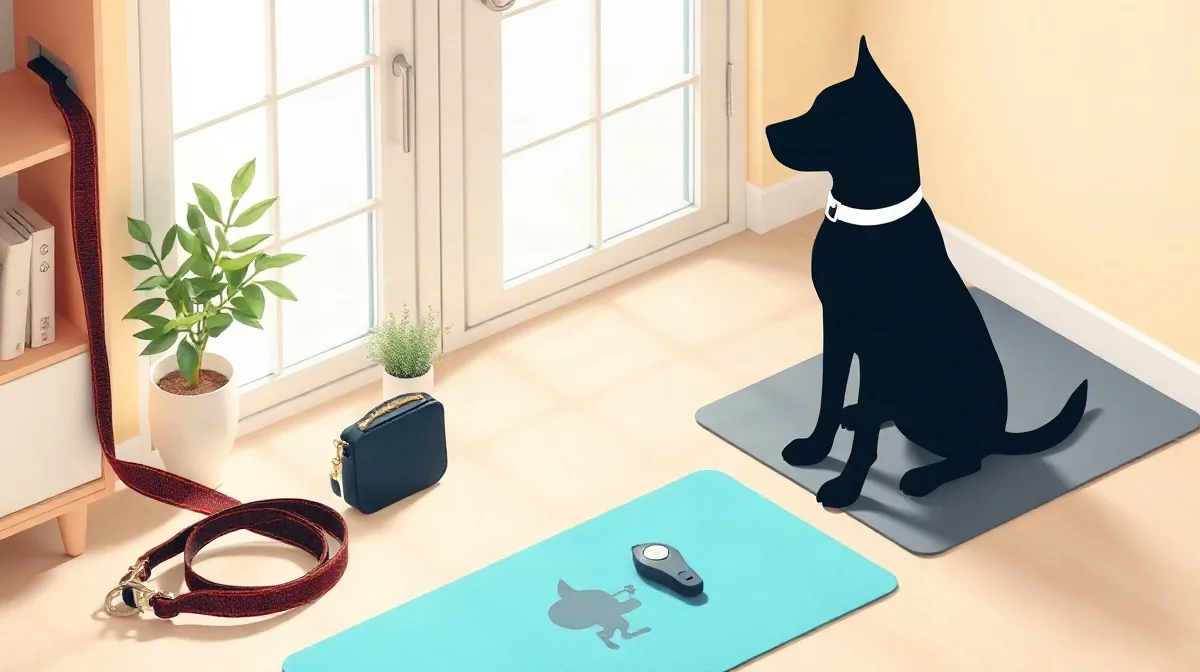
Home training is easier when rewards are immediate, the cue is clear, and the dog can practice in a predictable space. A treat pouch keeps food rewards within reach, a clicker or one marker word pinpoints the exact right moment, and a leash with a harness helps you guide short beginner drills without confusion.
- Treat pouch: keeps rewards ready so timing stays fast, which matters more than using a large treat.
- Clicker or marker word: marks the correct second once, instead of repeating a long cue.
- Leash and harness: give enough control for early practice before you move to parks or busy streets.
A calm setup for early practice
A mat or bed can become a settling station for meals, visitors, and work-from-home hours, because it gives the dog one clear place to relax. A quiet room is usually enough for the first repetitions, where the dog can learn without traffic, noise, or extra distractions.
That simple setup lets you build habits before adding harder environments. Once the dog understands the routine on a mat, with a leash, and in a low-noise room, you can gradually raise the challenge instead of starting in a crowded park.
How do you know training is helping, not just entertaining?
Signs of real progress
Training is helping when the dog needs fewer repeat corrections, recovers from distractions faster, and answers familiar cues more quickly. You should also see practical gains: the dog can relax on cue, walk with less pulling, and settle sooner after excitement.
- Fewer repeat corrections: one cue is enough more often.
- Shorter recovery: the dog returns to focus after a distraction in less time.
- Faster known cues: sit, stay, or come happens with less delay.
How to adjust the difficulty
If progress is uneven, make the task easier before asking for more. Shorten the session, lower the level of distraction, or go back to the rewards that worked best for the dog.
That reset keeps training useful instead of merely entertaining, because the dog can succeed often enough to build a habit. For broader ownership guidance, this fits naturally beside Dogs: A Complete Guide to Health, Care, Training, and Everyday Ownership.
Frequently asked questions
How long should a training session be?
Is a clicker necessary?
What if my dog knows the cue at home but ignores it outside?
Can training replace exercise?
Key takeaways
- Positive reinforcement is the simplest reliable training foundation.
- Sit, stay, come, and loose-leash walking solve many everyday problems.
- Short, consistent sessions beat long, inconsistent ones.
- Training supports calmer routines, safer handling, and better mental engagement.