
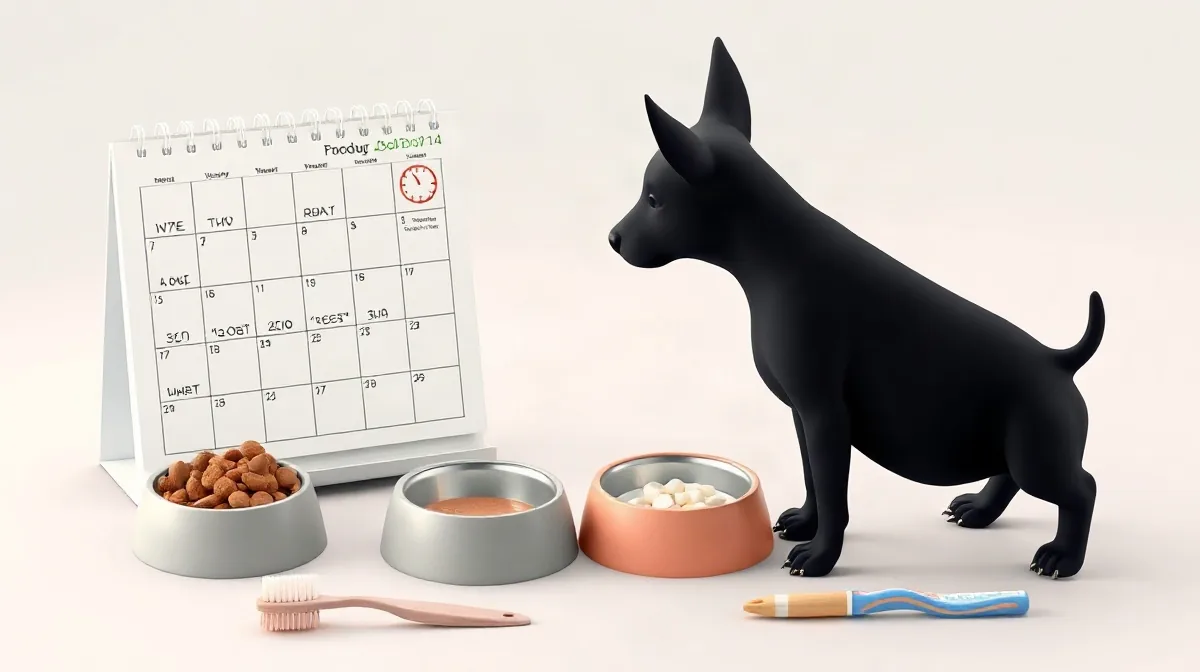
Updated: October 13, 2026
For a Bull Terrier puppy’s first year, build a steady routine around age-appropriate food, veterinary care, gentle socialisation, positive-reinforcement training, exercise and plenty of rest. Consistency helps your puppy learn what to expect while giving you a chance to spot changes in health or behaviour early.
Bull Terriers are strong, energetic dogs, so thoughtful care from the start can help channel their curiosity and enthusiasm into good habits. This guide walks you through the first-year basics, from settling in and house-training to daily care and the transition toward adulthood.
| Care area | Timing or threshold | Practical focus |
|---|---|---|
| Socialisation | 3–14 weeks | Gradual, controlled introductions |
| Feeding | Until 4 months | 4 meals daily; 3× resting energy needs |
| Feeding | After 4 months | 3 meals daily; 2× resting energy needs |
| Coat | Weekly | Soft-bristled brush; shedding may still be considerable |
| Teeth | At least 3 times a week | Brush regularly |
When should a Bull Terrier puppy meet new dogs and people?
Bull Terrier puppies should begin meeting people and calm, suitable dogs during the 3–14-week early-socialisation period, with introductions kept gradual and controlled. That window is a starting point, not a deadline: continue calm, consistent training after 14 weeks so social learning remains part of the puppy’s routine.
Keep early introductions manageable
Between 3 and 14 weeks, introduce a Bull Terrier puppy to individual people, everyday settings and dogs chosen for calm, appropriate behaviour. Let the puppy observe and approach at its own pace; do not force a greeting or close contact. Short, controlled experiences give the puppy room to adjust without turning each meeting into an overwhelming encounter.
Continue beyond the early window
Insufficient socialisation during the 3–14-week period can contribute to aggression towards other dogs in this headstrong breed. After that period, keep building the puppy’s experience through steady, low-pressure introductions and consistent training rather than treating socialisation as a one-time task. Watch how the puppy responds and give it space when it appears uncomfortable.
How much should a Bull Terrier puppy eat in the first year?
Meal pattern by age
A Bull Terrier puppy’s feeding guidance is 3× resting energy needs split across 4 meals a day until 4 months of age, then 2× resting energy needs split across 3 meals a day after 4 months. These energy multiples describe the guidance, not a measured weight of food to pour into the bowl.
- Until 4 months: divide the 3× resting-energy amount among 4 daily meals.
- After 4 months: divide the 2× resting-energy amount among 3 daily meals.
For both stages, choose a complete, balanced puppy diet and adjust portions by checking the individual puppy’s growth and body condition. The energy multiples alone do not tell you how many grams or cups of a particular food to serve, so use the food’s feeding information alongside those checks rather than treating the multiples as a portion weight.
Bull Terriers complete most of their growth by about 14 months, but the exact date for changing from puppy food to adult food can vary. Keep the distinction clear: about 14 months refers to growth, not a prescribed food-switch deadline. Ask your veterinarian to help judge the puppy’s growth and body condition when considering a diet change.
What exercise and training suit a growing Bull Terrier?
A growing Bull Terrier needs daily, age-appropriate exercise alongside short, consistent training sessions—not a fixed walk distance or a push through tiredness. Adjust activity to your puppy’s age and comfort, and let them rest when they seem fatigued.
Bull Terrier training works best when everyday skills are practised in brief, predictable sessions. Focus on coming when called and staying calm during handling, such as when you touch their paws or ears; repeat these exercises regularly rather than expecting a young puppy to master them in one long session.
Make routines and rewards predictable
A headstrong Bull Terrier can benefit from clear, repeatable routines and rewards for the behaviour you want to see. For example, reward a calm response to handling and return to you when called, then practise those same skills in familiar settings before adding distractions. Keep exercise and training separate from any attempt to test how long a tired puppy can continue.
How do you groom a Bull Terrier puppy’s coat, teeth, nails and ears?
A simple weekly checklist.
A Bull Terrier puppy’s coat, teeth, nails and ears need a simple routine: brush the coat weekly with a soft-bristled brush, brush teeth at least three times a week, trim nails regularly, and check and clean ears. This keeps the coat manageable while making dental and ear care part of the puppy’s regular handling.
- Coat: Use a soft-bristled brush for one weekly pass. Bull Terriers shed considerably despite needing relatively little coat grooming, so brushing does not stop shedding.
- Teeth: Brush at least three times a week.
- Nails: Trim them regularly.
- Ears: Check for dirt or wax and clean them as needed to help prevent infection.
Bull Terrier puppies can also be bathed occasionally when they need it. Keep bathing separate from the weekly brushing routine: a weekly brush is the stated coat-care practice, while a bath is for when the puppy is dirty or otherwise needs one.
Which health risks deserve attention during the first year?
During a Bull Terrier puppy’s first year, pay particular attention to persistent skin irritation and possible signs of hereditary kidney disease, and consult your veterinary team rather than trying to identify a cause at home. These are breed health concerns.
Atopic skin allergies are one reason to seek veterinary advice if irritation persists or the puppy’s usual condition changes. A change does not establish a diagnosis; describe what you have noticed and ask the veterinary team what assessment is suitable for your puppy.
Make checks individual to the puppy
Hereditary kidney disease is another concern to raise with the veterinary team, particularly when discussing the puppy’s family history. Ask which checks, if any, are appropriate for that individual puppy.
Routine care should also be tailored rather than treated as a universal calendar. Ask your veterinary team when to arrange visits based on the puppy’s health and history.
What first-year care advice should you not treat as a fixed rule?
Bull Terrier first-year advice should be treated as guidance, not a set of fixed rules: the 3–14-week socialisation window is a priority, not a deadline for forcing a fearful puppy into close contact with unfamiliar dogs. Let the puppy observe at a distance and approach only when comfortable; the stated age range does not mean every puppy is ready for the same encounters.
Bull Terrier feeding figures of 3× and 2× refer to resting-energy needs, not grams of food or universal portion sizes. The summary pairs 3× with four meals a day until 4 months, then 2× with three meals; those figures alone cannot determine how much food belongs in a bowl. Most Bull Terrier growth is complete by about 14 months, so reaching the first birthday does not establish that growth has finished.
Use care guidance as a starting point
Bull Terrier care details not specified in the material should not be turned into breed-wide schedules. It gives no exact exercise duration, bath frequency, nail-trimming interval or adult-food transition date, so do not present any of those as a Bull Terrier standard. Adjust those decisions to the individual puppy rather than treating the socialisation ages, meal counts or growth milestone as a complete care timetable.
Common questions
How often should I brush a Bull Terrier puppy?
How many meals does a Bull Terrier puppy need?
When is Bull Terrier puppy socialisation most important?
When has a Bull Terrier finished growing?
Key takeaways
- Prioritise gradual socialisation from 3 to 14 weeks.
- Follow the supplied meal pattern: 4 meals daily until 4 months, then 3.
- Brush the coat weekly, teeth at least 3 times weekly, and check ears and nails regularly.
- Ask a veterinarian about skin allergies and hereditary kidney disease concerns.
References
- Curafyt — “Bull Terrier: Traits, Training & Health Guide”
- PetMD — “Bull Terrier Dog Breed Health and Care”
- Royal Canin US — “Bull Terrier| Royal Canin US”
- alltailsvet.com — “Bull Terrier (Colored) – Breed Info”
- PlainBowl — “Bull Terrier Feeding Chart by Age & Weight”