
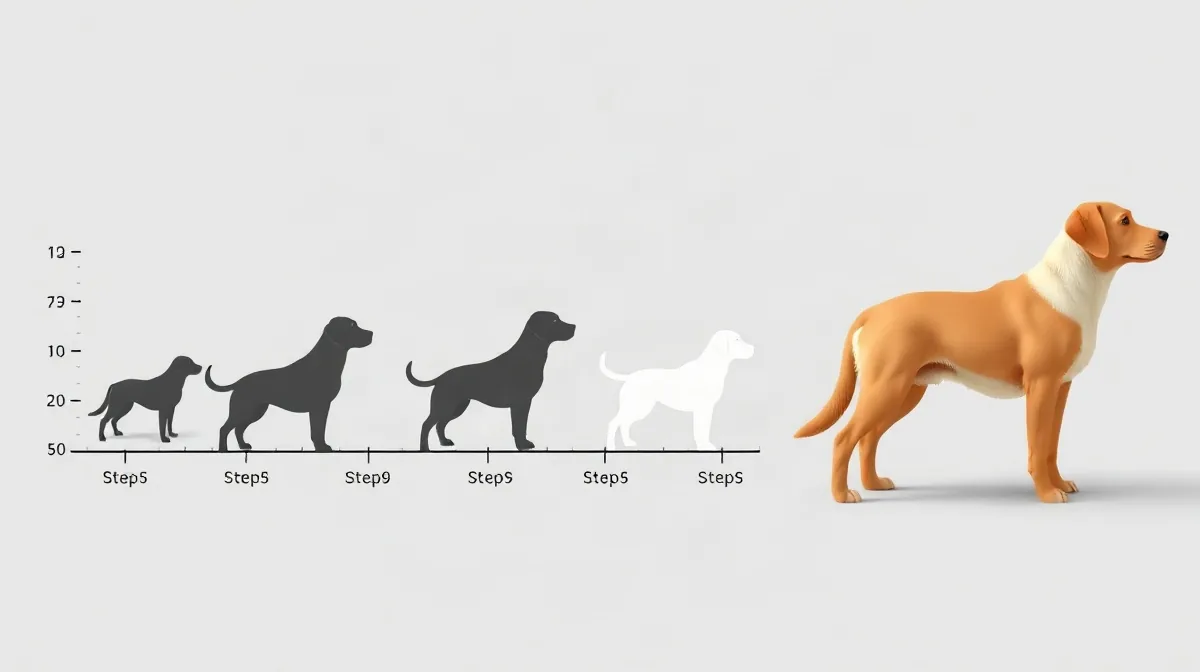
You can assess your dog’s body condition score at home by looking at their shape and gently feeling their ribs, waist and abdomen. A healthy score means the ribs are easy to feel without being prominent, the waist is visible from above, and the belly slopes upwards from the chest.
Weight alone can’t show whether a dog is carrying too much or too little body fat, so a body condition score offers a more useful visual and hands-on check. This guide explains what to look for at home and when to ask your vet for help interpreting your dog’s condition.
| Score or range | Ribs | Waist and abdomen |
|---|---|---|
| 4/9 | Easy to feel under a thin fat cover | Waist and abdominal tuck visible |
| 5/9 | Easy to feel without excess fat | Waist visible above; tuck visible from side |
| 8–9/9 | Difficult or impossible to feel through thick fat | Waist absent from above |
- 1–9 Points on the standard body condition score scale
- 4–5/9 Usual ideal body condition range for adult dogs
- 8–9/9 Scores indicating obesity in the supplied guidance
- 15–19% Body-fat range shown for score 4 in the supplied APOP chart
- 20–24% Body-fat range shown for score 5 in the supplied APOP chart
What does a dog’s body condition score measure?
A dog’s body condition score (BCS) estimates body fat by assessing the dog’s shape and how its ribs feel, complementing—but not replacing—body weight. The standard scale runs from 1 to 9, with 4–5/9 the usual ideal range for adult dogs. It describes physical features rather than prescribing a particular weight in kilograms, so two dogs with different builds can both be healthy at different weights.
What the score looks and feels for
A BCS assessment combines what you can see with what you can feel: at 4–5/9, the ribs should be easy to feel with light pressure but not prominent, the waist should be visible from above, and the abdomen should tuck upward when viewed from the side. These markers help distinguish body fat from size alone; a number on the scales cannot show where fat sits or whether the ribs are covered by excess fat.
Use 4–5/9 as a reference range, not a reason to make a major change based on guesswork. If a home estimate falls below 4 or above 5, or you are unsure of the score, have a veterinary professional assess your dog before changing feeding or activity substantially.
How can you check your dog’s body condition at home?
You can check your dog’s body condition at home by assessing the ribs, waist and abdominal tuck together, then comparing the overall shape with the 9-point body condition score (BCS). A score of 4–5 out of 9 is the usual ideal range for most adult dogs; no single sign determines the score on its own.
Ribs
Run your hands lightly along both sides of the ribcage. At BCS 4–5/9, the ribs should be easy to feel with light pressure but should not stand out visibly; a thick layer that makes them hard to find is not the ideal pattern.
Waist and abdominal tuck
For the other two checks, view your dog from above and then from the side. At the ideal score, the outline narrows behind the ribs when seen from above, and the abdomen rises upward behind the ribcage rather than hanging level with it.
Use the three observations as a combined check: ribs, waist and tuck. The 9-point scale reflects overall body shape and fat cover, so a prominent ribcage or a visible waist alone cannot establish a score; if your estimate falls outside 4–5/9 or you are unsure, seek professional assessment before making major changes to food or activity.
What does a healthy score of 4–5/9 look like?
A healthy score of 4–5/9 means a dog’s ribs are easy to feel beneath a light layer of fat, with a visible waist and abdominal tuck. The difference is that 4/9 is leaner, while 5/9 is the ideal midpoint for many dogs.
- At 4/9: The dog is lean, with ribs readily felt under a thin fat cover; the waist is visible from above and the abdominal tuck from the side. The supplied APOP chart places this score at 15–19%.
- At 5/9: Ribs remain easy to feel without excess fat, the waist is visible from above, and the abdominal tuck can be seen from the side. The APOP chart lists 20–24% for this score.
The APOP percentages are chart figures, not a substitute for checking a dog’s shape and feeling the ribs by hand. A home score should be treated as an estimate: if the dog appears outside the 4–5/9 range or the assessment is uncertain, seek veterinary advice before making major changes to feeding or activity.
Some athletic or working dogs may appropriately be kept toward the lower end of the 4–5/9 range, but that decision should be made with veterinary guidance. A score of 4/9 is therefore not automatically too low; the dog’s individual needs and hands-on assessment matter.
What do scores of 8–9/9 indicate?
A score of 8–9/9 on the standard nine-point Body Condition Score scale indicates obesity in the supplied guidance. At this end of the scale, a dog’s ribs may be difficult or impossible to feel beneath a thick layer of fat, and the waist is absent when the dog is viewed from above.
Those signs contrast with the usual ideal range of 4–5/9 for most dogs: ribs are readily felt with light pressure, and a visible waist can be seen from above. A single visual impression at home is not enough to decide how much food or exercise a dog needs, because the score should be assessed in context.
Before making major feeding or activity changes for a dog that appears to score 8–9/9, ask a veterinarian to assess its body condition. This helps avoid imposing a restrictive diet or a substantial exercise change on the basis of an uncertain home estimate.
When should a weight change prompt veterinary advice?
Arrange a veterinary assessment if your dog’s home body condition score (BCS) is outside the usual ideal range of 4–5 on the 9-point scale, or if you are unsure how to score your dog. Before making major changes to food portions or activity when the score is outside that range, get veterinary advice; assessment first is the current guidance.
A veterinarian can check whether the features you are using to score your dog match the scale: at BCS 4–5/9, the ribs should be easy to feel without being visibly prominent, the waist should show from above, and the abdomen should tuck up when viewed from the side. If you cannot confidently assess the ribs, waist or abdominal tuck, ask for a professional estimate rather than making a substantial diet or exercise change on guesswork.
Use weight alongside body condition
Body weight and BCS provide different information, so consider both when monitoring your dog. FEDIAF describes body condition scoring as a quick method used in addition to weight measurement: it takes account of body shape and fat layers, helping indicate whether a pet is underweight, at an ideal condition or overweight. Weight alone does not show those features; if the scale estimate is outside 4–5/9 or unclear, discuss both measures with your veterinarian.
Where can a home BCS check mislead you?
A home BCS check can mislead when you rely on one clue, treat body weight as a verdict, or read the score as a diagnosis. On the standard 9-point scale, 4–5/9 is the usual ideal range for most dogs, but the score comes from assessing body shape and feel together.
- Visible ribs: Ribs showing do not establish an ideal score. At 4–5/9, ribs should be easy to feel with light pressure but not visibly prominent; also check for a waist from above and an abdominal tuck from the side.
- Body weight: A number on the scale cannot show where fat sits over a dog’s contours. BCS adds a hands-on and visual check of fat cover, waist and abdominal tuck, so two dogs at the same weight may not have the same body condition.
- The score: BCS is a practical estimate, not a diagnosis or a kilogram target. If a home result falls outside 4–5/9—or you are unsure—ask a veterinarian to assess your dog before making major feeding or activity changes.
Dogs do not all need to look identical: some athletic or working dogs may be maintained at the lower end of the ideal range, but only with veterinary guidance. A lower-looking body shape alone is not a reason to assume that a dog needs more food or should be judged by the same outline as another dog.
Common questions
What is the ideal body condition score for most dogs?
Can I assess my dog’s BCS without a scale?
Is a score of 8/9 healthy?
Should I change my dog’s food after a home score?
Key takeaways
- The usual ideal for adult dogs is 4–5/9.
- At 4–5/9, ribs are easy to feel, the waist is visible and the abdomen tucks upward.
- Scores of 8–9/9 indicate obesity in the supplied guidance.
- Get professional advice before major changes if a home estimate is outside range or uncertain.
References
- modernanimal.com — “Modern Animal | How to Tell If Your Pet Is at a Healthy Weight: A Guide to Body Condition Scoring”
- pmc.ncbi.nlm.nih.gov — “A simple method to evaluate body condition score to maintain the optimal body weight in dogs”
- APOP — “Dog Body Condition Scoring | Assess Your Dog’s Weight”
- FEDIAF — “Maintaining a healthy weight for your dog”
- PetMD — “How To Find Your Dog's Body Condition Score”
